Six - September Art Exhibits
"Earthquake Picnic"
MassArt X SoWa Gallery
Boston, Massachusetts
August 26 – October 15
3rd Annual Alumni Group Exhibition at Massachusetts College of Art & Design opens Friday night!OPENING RECEPTION:
Friday, September 1, 5 PM – 9 PM
CLOSING RECEPTION: Friday, October 6, 5 PM – 9 PM"The Inevitability of Absence"
Culture Lab at the Plaxall Gallery
Long Island City, New York
August 31 – November 19
Curated by Tess Howsam and featuring the immersive performance, “The Incomplete Collection” by Linked Dance Theatre.OPENING RECEPTION: Saturday, September 3, 2 PM — 9 PM
"I am here"
Studio Montclair Gallery
Montclair, New Jersey
September 15 – October 20
A collaboration with OutMontclair at the Studio Montclair Gallery that explores what it means to be queer and be ourselves.OPENING RECEPTION: Friday, September 22, 6 PM — 9 PM
"Nor'Easter: The 53rd Annual Juried Members Exhibition"
New Britain Museum of American Art
New Britain, Connecticut
September 21 — October 8, 2023
This prominent show highlights the exceptional work of emerging artists in all media in a museum setting.OPENING RECEPTION:
Saturday, September 23, 12 – 1:30 PM"Artscape B23"
Artscape Baltimore Gallery Space
16 W North Avenue, Baltimore, Maryland
September 22 — 24, 2023
Artscape will include visual art exhibitions, main stage music
performances, culinary delights, community gathering spaces, immersive family & youth experiences, an artist marketplace, and so much more!OPENING RECEPTION:
Thursday, September 21, 6 PM — 9 PM"Diversity Lives Here: Representation Through Art"
Monmouth University Art Center
West Long Branch, NJ
March 15, 2023 – January 1, 2024
These artworks create spaces devoted to celebrating diversity, inclusivity, and representation on the Monmouth University campus. The aim of this project is to foster a greater sense of community, and ensure that all feel welcome on our campus.RECEPTION: Wednesday, September 20, Noon
Thanks for reading and being a supporter/collector of my artwork! If you would like a print of one of my paintings on canvas or paper...you can order one today on my site at
shopjoancoxartCabrillo Gallery Explores Human Identity
JOAN COX'S OIL PAINTING "LOVE IS EVERYTHING THEY SAID IT WOULD BE" WILL BE FEATURED IN CABRILLO GALLERY'S LATEST EXHIBIT.
ByJohanna Miller
Posted on March 3, 2022Cabrillo Gallery will open its first in-person exhibition of 2022 on Monday, with a show exploring the ways in which human beings see and express their own identities.
“Who We Are: Portraying Identity” will feature 38 artworks, from paintings and photography to mixed media and textiles. Gallery Director Beverly Rayner said that the show’s range is vast, likely due to the complex nature of identities.
“There’s everything from really humorous stuff to really serious stuff,” Rayner said. “Some of it represents more of a cultural or group identity, others are about gender identity … So it’s very personal.”
Rayner said she had been thinking about doing a show based on this theme for a while.
“It’s been high on my list for a long time,” she said. “It’s a big topic. And it’s on people’s minds … We hope people [who visit] see themselves and feel represented. and also feel empathy for others, and their realities. Identity is so complex. There are so many ways you shape, or recognize your identity in the world.”
Added Program Coordinator Victoria May: “There are a lot of unusual pieces that might make people dig a little deeper. Identity can be a sort of narrative … What narratives do we hold, deny, or tell ourselves?”
“Who We Are: Portraying Identity” opens Monday at Cabrillo Gallery. —contributed photo
An open call for artists resulted in about 300 entries to choose from. Juror Pauli Ochi of Ochi Projects in Los Angeles, along with Rayner and May, made the selections. A virtual Juror’s Talk with Ochi will be held March 12 at 4pm.“We chose Pauli to juror because her gallery represents a lot of artists who deal with the theme of identity,” said Rayner. “So we figured she’d be in tune with what we wanted to do.”
Both Rayner and May expressed how glad they were to be back in the gallery, seeing and experiencing art in person.
“When we get the pieces in the mail, open them up … it’s like, ‘Wow!’” May said. “Certain art has so much more vibrance, textures … There’s such a different feeling, seeing these works in person.”
“Who We Are: Portraying Identity” runs through April 8. Library Building: Room 1002, Cabrillo College, 6500 Soquel Drive. Monday-Friday, 9am-4pm; Monday and Tuesday evenings, 7–9pm. Free admission.
LifeBridge Health Medical Moment - featuring my mural
Advances in Radiation Therapy at the Alvin & Lois Lapidus Cancer Institute
Kerry Cavanaugh, Host, Medical Moment WBALTV11
Baltimore, MD
March 20, 2018
Patients needing radiation treatment are benefitting from a new technology that uses six different tools to target a tumor for improved accuracy. Sinai Hospital is the first in Maryland to use the new Varian Edge, which delivers radiation with pinpoint accuracy to tumors in faster treatment times – as little as 10 minutes.The Edge has the ability to deliver radiation to tumors in all areas of the body, and its tracking system adjusts to tumor movement resulting from patient positioning changes and breathing. Its accuracy means that nearby organs and tissues receive lower radiation dosages and fewer sessions are needed to complete treatment.
The Edge is the only completely hybrid machine that provides conventional and stereotactic (high dose, highly focused) therapy and it is connected to the patient's electronic medical record limiting time needed for planning and data capture.
In this Medical Moment, you will see how the latest technology at Sinai Hospital provides radiation therapy with pinpoint accuracy for a breast cancer patient. Dr. Jeanette Linder, chief of radiation oncology at the Weinman Family Department of Radiation Oncology for Sinai Hospital and medical director of the Alvin & Lois Lapidus Cancer Institute at Sinai and Northwest hospitals, explains how the new technology provides better coverage in shorter time, and in a beautiful setting unique to Baltimore.
Baltimore Mural at Sinai Hospital
January 16, 2018
by Jessica CartagliaBALTIMORE (WJZ)– Undergoing treatment for cancer is physically and emotionally draining.
Radiation oncologists at Sinai Hospital are using a new radiosurgery system called the Varian Edge, which is non-invasive and can pinpoint very small specific areas for the treatment of tumors.
Now, thanks to a local artist, patients being treated at Sinai have something beautiful to focus on… in an effort to ease some of the pain.
The Edge system uses high-dose radiation with sub-millimeter accuracy to precisely target tumors all over the body including in the brain, spine, lungs and prostate. This also reduces radiation exposure to nearby healthy organs.
Dr. Jeanette Linder is Chief of The Weinman Family Department of Radiation Oncology at Sinai Hospital. She says that while the technology is incredible… “It’s very scary. There are things happening out of your site, and even while we are talking to them and playing music, it’s still very, very frightening.”
In an effort to make a difficult situation a little easier, staff at Sinai reached out to Baltimore artist, Joan Cox.
Cox, was quickly commissioned to create a ceiling mural to go above the Edge system.
“We talked about Baltimore things and they really wanted that feeling,” Cox says.”And the first thing that came to mind was Pimlico, because it’s right next door of course.”
Across the ceiling, above the Edge treatment system is a colorful collage of custom illustrated images representing Baltimore. Among the many things patients can find are row homes, Pimlico Race horses, Black-Eyed Susans, the Bromo Seltzer tower, a raven, an oriole and other embedded images. There are also multiple symbols of hope and happiness such as hearts, ribbons and butterflies.
“I wanted that ‘OK, you’re down the rabbit hole feeling,'” Cox says. “You’re down here and you’re looking at this beautiful world blossoming above you.”
Dr. Linder agrees.
“We like seeing that balloon,” Dr. Linder says. “It’s like it’s carrying away their worries, and their tumors and they can find all sorts of hope in there.”
Recent Press Coverage - Baltimore Sun
Women get a lot of exposure in two exhibits at community college
Mike Giuliano
Howard County TimesA couple of exhibits at Howard Community College present figurative depictions of women that stylistically range from the expressive to the surreal. Just about the only thing not present is straightforward realism.
The group exhibit "Women of Myth, Splendor, and Irrefutable Morals" in HCC's Rouse Company Foundation Gallery and Janice Crum's solo exhibit titled "I hate it when you (Please) look at me" in its Art Department Gallery are equally bold thematically and in their use of various materials.
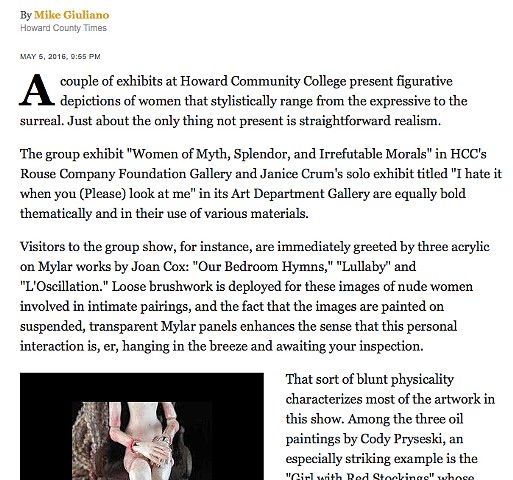
Visitors to the group show, for instance, are immediately greeted by three acrylic on Mylar works by Joan Cox: "Our Bedroom Hymns," "Lullaby" and "L'Oscillation." Loose brushwork is deployed for these images of nude women involved in intimate pairings, and the fact that the images are painted on suspended, transparent Mylar panels enhances the sense that this personal interaction is, er, hanging in the breeze and awaiting your inspection.
That sort of blunt physicality characterizes most of the artwork in this show. Among the three oil paintings by Cody Pryseski, an especially striking example is the "Girl with Red Stockings" whose fleshy figure is only clad in those attention-grabbing stockings. The sensuously loose paint application and general aura of happy hedonism may remind viewers of the approach to female figuration taken by an artist who is not in this show, Raoul Middleman.
Casually presented nudity also characterizes the three untitled graphite drawings by Tanya Ziniewicz. These all feature bare-breasted women posing for solo portraits.
Assertive female portraiture is also found in the graphite drawings by Ellen Durkan, which express a cyberpunk sensibility; and also Stephanie Schafer's digital photomontage and acrylic on canvas portraits that rely on presenting the female models with dramatic makeup and costuming.
Moving into another medium, Shin Yeon Jeon's ceramic sculptures, among them "Theresa," exert a three-dimensional presence in the gallery space.
Bringing classical allusions to the figurative mix, Christopher Koch's pastel on cardboard "Study for the Graces Meet the Minotaur" and "Study for the Graces in Their Boredom" primarily rely on thinly drawn schematic lines to conjure up mythic references to women.
Things venture into the surreal for most of these artists. Yiyun Chu's ink drawing on watercolor paper and Adobe Photoshop "Where Are You, Darling?" features a woman seated beside a campfire in the forest at night. She's flanked by wild animals that seem comfortable nestling next to her.
Additional surreal landscapes can be seen in Greg McLemore's oil paintings, among them "G.D.," with its placement of a person seen against a dry and barren plain.
"Where Are You, Darling?" by Yiyun Chu (Submitted photo /)Surreal to an extreme degree are Lania D'Agostino's three "Animalia" mannequin figures made out of fiberglass, resin, cardboard, oil and acrylic paint, and mixed media. They have animal heads, brightly colored fur and in general convey a sense that they are female figures of a mythic stature.
In Janice Crum's solo show, the artist makes small nude sculptures of women that also tend to have mythic or surreal attributes.
Somewhat setting her work apart from what's found in the larger group exhibit is that Crum often has religious references that include ornate gilded frames that you would expect to find around portraits of saintly figures; reliquary-evocative boxes containing sculptural forms; and the thematic sense that at least some of these mini-figures have suffered in ways that make them candidates for sainthood.
"Women of Myth, Splendor, and Irrefutable Morals" and "I hate it when you (Please) look at me" run through May 8 at Howard Community College, 10901 Little Patuxent Parkway in Columbia. Go to www.howardcc.edu
STUDIO INTERVIEW
I was interviewed in my home studio in March 2015 by Kat Harvey for her Success Nothing Less show out of Washington DC. You can get a virtual tour of the studio and hear me talk about of my lesbian themed paintings.
REVIEW OF GUTSY EXHIBIT at GALLERY CA
A 'Gutsy' Feminist Art Project show at Gallery CA
The exhibition features highly personal work from 22 regional artists
August 02, 2014
By Mary Carole McCauley
The Baltimore SunARTIST RAISES EYEBROWS, OPENS MINDS WITH 'TABOO'
Baltimore Gay Life article by Kelly Neel
Local Mixed Media Artist Raises Eyebrows, Opens Minds with "Taboo"
By Kelly NeelExploring the shared intimacies between women in lesbian relationships, Baltimore artist Joan Cox’s solo exhibit Taboo brings to light the genuine and tender connection experienced when two women fall in love. Through the use of various mediums, from acrylic and oil painting to photography, Cox’s portraits depict wonderful moments of closeness between real lesbian couples of all different backgrounds. Her exhibit works to dissolve the stigma around lesbian relationships while displaying a subject that has been so scarcely represented.
Cox’s exploration of these intimate moments began after painting a double portrait of herself and her partner. The piece titled “Night Hunger” (pictured above, left) is a nod to Austrian-born painter Xenia Hausner and is a reinterpretation of one of Hausner’s works. From this first reinterpretation stemmed an interest in infusing historical works of art with a new perspective. Referencing artists from Gustave Courbet to Frida Kahlo, Cox revisits historical pieces and reinvents them to create a new perspective and offer a new dimension to the works. With “The Lovers” (pictured above, right) Cox reinterprets Egon Shiele’s “Lovers” to depict a rather intimate moment between two women, rather than a man and a woman.
The exhibit also plays on ambiguity and androgyny. It is only upon closer examination that the viewer can distinguish the figures as female. The idea that these images could just as easily be of heterosexual couples creates a dialogue that further conveys that the love between two women is just as valid and true as any other form of love. These moments of tenderness and love are universal, not taboo.
Through the use of soft colors and juxtaposing strong brush strokes, Cox’s acrylic works are romantic and intense; capturing so elegantly the real emotions experienced within relationships. Add to this her bold canvases and beautiful photographs and you get a cohesive exhibit that remains as diverse as its subject matter.
Taboo will be on display at the Silber Art Gallery of Goucher College from October 22 to December 8. The exhibit is free and open to the public every Tuesday through Sunday from 11am to 4pm. An artist’s reception will be held Friday, November 8th, 2013 from 6 to 9 p.m. in the Silber Gallery. Please visit www.goucher.edu/silber or Call 410-337-6477 for more information.
Taboo by Joan Cox
Free • Thru Dec. 8
Silber Art Gallery at Goucher College
1024 Dulaney Valley Rd. • Towson
Goucher.edu/silber>>TABOO: Solo Exhibition
Taboo
Sept. 22 - Dec 8, 2013
Artist's Reception
Friday, November 8, 6-9 pm
Silber Art GalleryTaboo, a solo exhibition by Joan Cox will be presented at the Silber Art Gallery on the campus of Goucher College from October 22 through December 8, 2013. This exhibit, which is free and open to the public, can be viewed Tuesday through Sunday from 11a.m. to 4 p.m. An artist’s reception will be held Friday, November 8th, 2013 from 6 to 9 p.m. in the Silber Gallery. Please visit Silber Art Gallery or Call 410.337.6477 for more information.
>>MFA THESIS EXHIBITION
MFA Thesis Exhibition
Saturday, Sept. 14, 2013
6-9 pm
Campus of Fine Arts Work Center, Provincetown, MA
Hudson D. Walker GalleryI graduated with my MFA from the low-residency painting program at MassArt with a thesis exhibition on Saturday, September 14, 2013 in Provincetown, MA.
>>RECENT WRITINGS on BmoreArt.com
I am interviewing artists, critics, curators and other exciting arts professionals. Read more at interview
>>"MFAWC: OFF THE GRID" group exhibit at Arnheim Gallery
November 19 – 29, 2013
Arnheim Gallery Info“Off the Grid” gives viewers a peek at the work created by the 2013 graduate students from the MassArt Low-Residency MFA program. The artists from Boston, Colorado, Florida, Maryland and Rhode Island come together twice a year to hone their practice and create work during an intensive residency at the Fine Arts Work Center in Provincetown. This exhibit highlights a recent visual investigation by each of the candidates: Terry Boutelle, Diane Cionni, Joan Cox, Edgar Sanchez Cumbas, Lisa Daria Kennedy, Julianne Martin, Vincent Wolf.
Arnheim Gallery at MassArt
Gallery info: 617.879.7550>>EXHIBIT at WARD CENTER FOR THE ARTS
Scooter paintings are on view at the Ward Center for the Arts at St. Paul School for Girls in Baltimore. Closing reception will be Thursday, October 6th, 2011 at 7:30 in the evening.
>>OLD TOWN SERIES ON EXHIBIT at ALEXANDRIA CITY HALL
January - July 2011
The Alexandria Commission for the Arts coordinates and sponsors an Art in Public Spaces Program. My work was accepted into the program and is currently hanging in the 2nd Floor of City Hall in Alexandria, VA through mid-July 2011. All works are for sale.
>>ACCEPTED INTO "STUDIO VISIT" MAGAZINE
I just received news that my artwork was accepted into the spring 2011 edition of "Studio Visit" magazine published by The Open Studios Press.
The 13th Edition of Studio Visit is hitting mailboxes the second week of April 2011!
>>FEATURED ARTIST ARTICLE
Check out this great article about me and my scooter paintings on the Helmet Hair magazine website.
>>EXHIBIT AT GALLERY 211 in Baltimore
SCOOTER PARKING ONLY
Gallery 211 This great little gallery in Federal Hill
showed my recent scooter art in the summer of 2009.The exhibit ran from June 26 - August 22, 2009
>>"THE RETURN OF ART"
FSVIEW, Florida, August 31, 2006
The struggling and surviving art scene in New Orleans
By Darby PriceFlying low over Lake Pontchartrain, staring out at the placid waters, one may easily forget that only a year ago, those waters were breaking through the levees of New Orleans, flooding about 80 percent of the city.
As Aug. 29 comes and goes, the citizens of New Orleans are bombarded with the images and stories of Hurricane Katrina, some of them terrible, some of them inspiring. The reality of the city is that the people who were able to come back are trying to rebuild in a place that often seems lifeless.
"The city has definitely changed," Tulane senior Lee Pratka said. "It's like living in a third world country now."
In the midst of the economic and emotional depression that seems to grip the city, the residents are reverting back to the one thing that forms the backbone of their community: art.
New Orleans is known for its art, be it jazz, the Louisiana-inspired paintings of Edgar Degas, or even the street performers who dutifully pose as statues or sing renditions of The Temptations songs.
"We used to vacation here about a week every year, and we just loved it," Director of MOXY Studios and artist Joan Cox said. "We loved the feeling of (the city)."
Originally from Baltimore, Cox and her partner set up their Magazine Street studio just six weeks before Hurricane Katrina hit. After leaving the city for four months, Cox returned to find that her gallery had only suffered minimal damage, but the storm's effects on her customers was harder hitting.
"We're just hanging on by our fingernails," Cox said (referring to the plummet in tourism dollars). "Along with all the other galleries and shops in the area."
In fact, the one thing that keeps the art scene alive in New Orleans seems not to be the shop-happy tourists, but the loyal residents whose emotional attachment to the city and emotional response to the destruction and disruption caused by Hurricane Katrina seem to be pushing them to rally around their fellow residents and around the lore of the city itself.
"There have been two repeated comments," Cox said. "One of which is "I just need something happy to look at, I need something colorful," and then other people coming in just saying, "Do you have anything at all about New Orleans?" There's such an emotional tie to the city and to images of the city as it was and as it is."
The impact of the hurricane is not so much in the broken wood and the moldy plaster. It lies much closer to the inborn pride that the citizens of New Orleans carry with them, a pride for a culture that cannot be torn apart by wind and waves. The grief is for lives turned upside down and communities of people being split and scattered across the country. The determination is for a brighter future and a return to normalcy.
"Some of our buyers are not in their homes," Graphic designer for MOXY Studios Mare McCall said. "Some people are buying pieces that they can put in their houses once they're rebuilt."
For the artists who call this city on the Mississippi home, life has changed drastically while inspiration has sky-rocketed.
"I have always painted New Orleans," local artist Alan Flattmann said. "I am planning a show in December that will be nothing but pieces about New Orleans at night or on rainy days."
Even regular citizens are a part of the art scene now; at the New Orleans Museum of Art, a striking exhibit entitled "Katrina Exposed: A Community of Photographs" is on display until mid-September. The gallery walls are covered with photographs taken by professionals and regular citizens alike. Some are humorous, like one picture of a drowning sign that reads, "Smile, New Orleans!" Others, including several pictures of corpses lying face-down, are chilling and stark.
The hundreds of photographs reveal that the community of people affected by Hurricane Katrina spans several economic and social strata. These are the people who must now rebuild from the ground up, and they are desperate for ways to express their hardship and renew their strength.
The art is now no longer in brushstrokes or in the notes coming from the saxophone; it is in the tones, the ability to simultaneously uplift and give voice to all the grief and hope that remained when the floodwaters receded.
Recommended Art Feature
Gambit Weekly, New Orleans, August 1, 2006
Recommended
By D. Eric BookhardtSome galleries have all the luck. When Joan Cox and Mare McCall moved here from Baltimore and opened an art gallery called Moxy last July, little did they know Hurricane Katrina would hit a mere few weeks later. Like most of Magazine Street, Moxy came through the storm intact, and while surviving the post-Katrina economy hasn’t been easy, their current show, Night and Day, marks the anniversary of the gallery’s opening. Cox says she had wanted to do a show of paintings set in the nighttime but worried that might seem “a little too dark,” and then some ambient strains from Cole Porter’s Night and Day suggested a solution. Featuring a mix of local and out-of-state artists as well as some of Cox’s own canvases, Night and Day celebrates continuity and the hope of better days ahead.
ARTWRAP Art at Results By John Blee
The Georgetowner February 23, 2005
ARTWRAP
Art at Results
By John Blee
Results Gallery at Results Gym (315 G Street SE, 202.669.4226) is one of several alternative spaces around DC presenting art that is overlooked by commercial galleries. Here we have an ambitious show with Nathan Richardson, Joan Cox, and Marcia Dullum.Nathan Richardson is an American painter who lives and works in Germany. Although he spent all his formative years in the U.S., his work is definitely informed by his stay in Europe. Richardson’s pictures are serial in nature and consist of (mostly) three figures (mostly frontal) in a space that maintains ambiguity. The space could be a room or cave, but it has an atmosphere that is pressurized as in Rothko.
Richardson has a grave, almost elegiac tone in these works. In "Naked Light," you feel the linen ground through the paint. The roughness of the ground establishes the physicality of the pictures. In "Only a Game," a small game board is seen off to the side. There is extensive, yet restrained use of pencil and sgraffito. "Blue Passage" has eloquence in its color like the final moment in which an ember dies. In all the work there is the evidence of the physical weight of being.
The light around the figures in these works acts like halos or emanations, perhaps psychic. There is pathos in these very reductive forms that remind me of Rothko’s geometry and of Stonehenge. "Snowflake June" has a red that shifts the weight of the picture. "Fool Anybody" is flatter, more decorative in its spatial aspect, with more broken passages than the other work.
Nathan Richardson, in speaking about his work, refers to Huxley’s "Brave New World" and says these pictures "are a social commentary on what I see around us." They are also a personal vision of an inner world.
Joan Cox is an energetic colorist. Her work is often based on flowers seen in flower markets and has an expressionist edge and delivery. It is never purely decorative and she is willing to take on subject matter that could throw another painter such as an up-close, oversize face sucking on a straw. Cox’s "Sweet Pears" have the sweetness of the title. Her "Violette" is jumpy and fun.
Marcia Dullum’s work is informed by many sources. In "Tribute to Bonnard," one senses more Diebenkorn than Bonnard. She is best at her non-figurative work that relates more to landscape. Her "Ricochet in Red" stands out.
Gary Fisher, Art Director of the Results Gallery, who works from the assumption that “there could be a Van Gogh in any artist exhibiting early promise," is to be congratulated on his effort. (Through March 27, 2005)
Paintings would beautify any home Art: by Glenn McNatt
Baltimore Sun, Dec 24, 2002
Paintings would beautify any home
Art: by Glenn McNatt
In a holiday season with omens of war in the offing, art that's warm and fuzzy and frankly decorative in intent may be just the thing to help us through a New Year fraught with uncertainty.So you may want to check out the lovely show of contemporary-style Post-Impressionist paintings by Joan Cox and Sheep Jones at the Beveled Edge Gallery in Mount Washington. (So what if Post-Impressionism is already more than 100 years old? Some styles never lose their charm.)
Forget about the accompanying artist's statements that seem to want to weigh down these well-crafted, brilliantly colored botanical images with more than their fair share of profundity. Why shouldn't a painting just be a pretty thing to put on a wall, no explanation needed?
Cox's large paintings of pears, plums and flowers show that she has studied Cezanne and van Gogh and their painterly renderings of organic volumes (also, perhaps, the still-life experiments of early photographic Pictorialists like Clarence White and Edward Steichen).
She favors a harmonious but rather intense palette of blues, oranges, yellows and rusts that make her fruits seem to sit up on the canvas and beg to be touched, against backgrounds that are sometimes smoky and mysterious, sometimes all clear luminous innocence.
Some of Cox's paintings incorporate poetry or poetic phrases in the image, also purposeful scratches, drips and splashes of turpentine that add visual interest without distracting too much attention from the main subject.
In short, these are paintings that are easy to like, and probably easy to live with, too.